|
|
| Uncle Dynamite
|
|
Main page / Bibliography / Uncle Dynamite
|
First published in UK: October 22 1948 by Herbert Jenkins, London
First published in US: December 3 1948 by Didier, New York
 Russian translation Russian translation
Russian text (265K)
It is avowed mission in life of Frederick Altamont Cornwallis, fifth Earl of Ickenham,
to spread sweetness and light come what may.
From boyhood his has been a gay and happy disposition, and in the autumn of his life he still
retains the fresh, unspoiled mental outlook of slightly inebriated undergraduate.
A keen matchmaker and intrepid impersonator, Lord Ickenham is in his element when at large
on a sweetness-and-light-spreading excursion. On this occasion the hapless object of his
benevolence are his love-lorn nephew, Reginald ('Pongo') Twistleton, and Pongo's former
crony, Bill Oakshot. Invariably a mixed blessing, this time the gleam in Uncle Dynamite's eye
heralds trouble of a major kind...
|
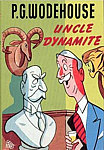
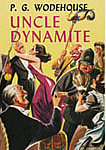
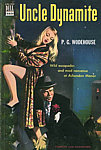
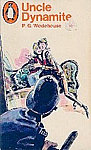
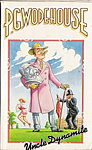
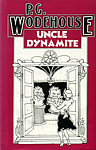
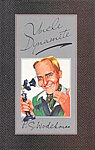
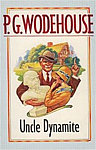
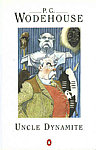
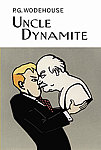
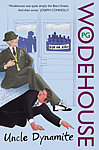
Click for enlarge book cover
|
|
Characters
Frederick Altamont Cornwallis, 5th Earl of Ickenham — 60 year old uncle of
Pongo's who went to school with Sir Aylmer and Major Plank and was known
there as Barmy. Wants Pongo to marry Sally.
Bill Oakshott — Childhood pal of Pongo's who is shy and loves Hermione
(Pongo) Reginald G. Twistleton — Lord I's nephew who inherited a pile of
money and is engaged to Hermione
(Mugsy) Sir Aylmer Bostock — Bill's 57 year old uncle, an ex-colonial
governor who is running for Parliament
Hermione Bostock — Sir Aylmer's determined, intellectual
daughter whom Bill loves with silent devotion. Engaged to
Pongo and writes novels under the name of Gwynneth Gould
(Bimbo) Major Brabazon-Plank — Lead an expedition to the Lower Amazon which
included Bill
Coggs — Lord Ickenham's butler
Sally Painter — Small, pert American sculptress who used to be
engaged to Pongo and loves him still
Otis Painter — Sally's brother who published Sir Aylmer's reminiscences
Lady Emily Bostock — Sir Aylmer's devoted wife
Harold Potter — 28 year old Police Constable engaged to Elsie.
Before being transferred to Ashenden Oakshott, he had
arrested Pongo and Uncle Fred at the Dog Races in London.
Elsie Bean — Housemaid at the Manor engaged to Harold
Mrs. Gooch — Cook at the Manor
Mrs. Bella Stubbs — Harold's 33 year old sister
Jno. Humphrey — Landlord of the Bull's Head
Erbut (*)
Augustus Popgood (*)
Cyril Grooly (*)
Jane (*)
Myrtle (*)
Percy (*)
|
 Synopsis Synopsis
Hikaru Nagi Forum — Repack
"Hikaru Nagi Forum Repack" — the phrase lands like a fragment of something larger: a username, a niche community, an archival project, an inside joke folded into digital culture. To contemplate it is to trace the braided threads that give online artifacts their life: identity, curation, loss, and the human urge to gather and keep. I. Name as Artifact "Hikaru Nagi" reads like a crafted identity. Hikaru (light, radiance) and Nagi (calm, lull) combine contrast and balance; together they suggest a persona both luminous and serene. Attached is "Forum" — an unmistakable nod to communal exchange, threaded conversations, timestamps, and the particular grammar of early-Internet social life. "Repack" complicates this: it implies selection, compression, reconfiguration. What once existed as scattered posts, images, and conversations is now being reassembled. Repackaging transforms ephemeral interaction into an object meant to persist. II. The Ethics and Aesthetics of Repacking Repacking is curatorial labor. It can be tender — rescuing orphaned culture from link rot — or intrusive, reorganizing content for new narratives. Ethically, repacks raise questions: whose voice is preserved, whose context is lost, and what consent exists for the new form? Aesthetically, a repack creates a new artifact: design choices (ordering, omission, annotations) steer perception. The repacked "Hikaru Nagi Forum" might foreground wit, grief, or mundanity, depending on the curator’s eye. Each choice reframes history. III. Memory, Nostalgia, and Digital Decay Forums are palimpsests of memory: overlapping conversations reveal changing interests, inside jokes, and vanished norms. Repacking enacts nostalgia — it stitches a coherent narrative from scattered moments. But nostalgia risks sanitizing: the mess, the moderation disputes, the dead links — these are all part of the original ecology. A repack can be archival balm against digital decay, yet it may flatten the unruly texture that made the forum alive. IV. Community and Ownership A forum is more than content; it’s relationships. Repackaging a forum tests boundaries of ownership. Does an assembled archive belong to the original posters, the forum host, or the person who saved it? Ownership questions echo in legal and moral domains. Practically, repacks can foster renewed community — a memorial, a reunion, a resource for study — or they can alienate, turning intimate exchange into a public exhibit without invitation. V. The Poetics of Compression "Repack" evokes compression: threads condensed into PDFs, images embedded into galleries, timestamps collapsed. Compression is poetic: it asks us what is essential. The repacker becomes an editor of memory, choosing moments that encapsulate tone, humor, or turning points. In a well-done repack, selected fragments create a montage that sings with context while inviting readers to reconstruct the whole. In a poor one, nuance is lost, and voices flatten into monotone. VI. Future Echoes Once repacked, a forum fragment circulates anew — cited, mined, remixed. The "Hikaru Nagi Forum Repack" may seed creative projects, academic inquiry, or fan mythmaking. It may also become evidence in future debates about authorship, consent, and the right to be forgotten. Every repack is a time capsule whose later opening will reveal as much about the repacker’s era as about the original community. VII. A Modest Prescription If tasked with creating or evaluating such a repack, prioritize: transparency (document selection criteria), consent (notify or anonymize contributors), context (preserve timestamps, moderation notes, and thread structure), and accessibility (format for both human reading and long-term preservation). These practices honor both the artifact and the people who made it. VIII. Closing Reflection "Hikaru Nagi Forum Repack" is more than a label; it’s a crossroads where identity, curation, memory, and ethics intersect. Repacking is an act of translation — turning dispersed human expression into something portable and enduring. When done with care, it can rescue a small world from oblivion and offer future readers the faint, vital pulse of a community that once shared light and calm in the quiet geometry of forum threads. |
|

 Russian |
Forum |
Contact Us
Russian |
Forum |
Contact Us